


The following information is show-specific regulations which apply to all space only stands exhibiting at ICE to ensure safety and accessibility. In addition to the below, all stands should be designed and built in line with the G-Guide, Venue Regulations, and the Spanish Technical Building Code (CTE). The ownness is on the Exhibitor and their appointed Stand Contractor to familiarise themselves with the relevant documentation.
Stand Design Guide and Regulations
Stand Plan Inspection Agency

Event Support Solutions (ESS) have been appointed by Clarion Gaming to collate, inspect and manage space only stand plan submissions.
The business has been established 15 years and 2027 will be the 9th year they have collaborated with us on ICE.
ESS have a vast knowledge of regulation compliance and work with exhibitors and contractors to ensure all paperwork required by the Engineers and Venues is provided whilst supporting Clarion Gaming meet our legal requirements and assure exhibitors adhere to our house rules.
Their aim is to assist Exhibitors and their appointed contractors avoid potential issues onsite due to unintentional contravention of Organiser or Venue regulations by effectively communicating the standfitting and Venue regulations.
Deadlines
Double Decker Full Submission: 2nd October 2026
Space Only Complex Stand Plan Deadline: 16th October 2026
Space Only Non-Complex Deadline: 6th November 2026
Contact Details: iceplans@eventsupportsolutions.com
Space Only Stand Plan Submission Documentation
The following information must be submitted in full by the deadline for both complex and non-complex stands.
All information is to be submitted in English and include exhibiting company’s name and stand number.
Please make a complete submission to Event Support Solutions (ESS): ICEplans@eventsupportsolutions.com
_______
Required Documentation
• Stand Design Inspection Form
• Scaleable plan view drawings showing the overall stand dimensions, all dimensions of stand fitting, walling, construction and entry/exit points as well as the location of furniture and exhibits. Dimensions should be in centimeters, millimeters and meters. Elevation view drawings showing all build heights, including any rigging.
• 3D drawings of all open sides.
• Layout plan of the stand showing positioning and description of exhibits.
• Risk Assessment for the build and dismantle of the stand.
• Method Statement for the build and dismantle of the stand.
• Fire Risk Assessment for the stand once it is in use.
• Construction Phase Plan for the construction and dismantle phases.
• Details of any rigging (suspended elements from the hall ceiling).
• Completed Intention to Rig form (suspended elements from the hall ceiling).
• List of stand fitting materials confirming their compliance with G-Guide regulations and the Spanish Technical Building Code. If using truss in the construction of the stand, you should include details of the system being used.
- PLI - with clear evidence of value, date and company name of the PLI holder.
• Waste Management Plan.
________
For complex stands, the additional information detailed below is required:
• Construction drawings & static calculations to prove the stability of all complex structure/s.
• For multi-storey stands and stands with steps, you must submit step, handrail and balustrade drawings showing all step dimensions, handrail & balustrade heights and details of handrail & balustrade infills. Loadings for each element must be detailed in the calculations.
• For super platforms & multi-storey stands, you must submit a two-storey Method Statement.
________
If your stand design incorporates complex rigging, e.g. timber structures, suspended stand build, canopies, metal structures and suspended exhibits, the following information will be required:
• Construction drawings and static calculations to prove the stability of the rigging structure.
• Calculations to prove that the rigging elements are capable of span between rigging points.
• Lifting tackles are to be proved capable of supporting the weight of the elements.
• Lifting points must be clearly indicated in the drawing(s) together with magnitude of load for each individual suspension point.
• If standard trusses are incorporated into support the elements, calculations are to be provided to prove its capacity.
If your stand design incorporates complex rigging e.g. modified banner systems or simple logo drops, the following information will be required:
• Banner system manufacturer specification document and construction drawing of amendment showing materials, total weight, load per point, fixing connections and their rating.
• Construction drawing of element along with material, total weight, load per point, fixing connection and their rating.
Submitted information should be in the form of drawings and calculations. Drawings should contain enough detail to show exactly how the stand elements will be rigged including: connection details between venues rigging point to suspended elements, construction details of joints between elements etc. All lifting equipment/lifting tackle (i.e., eye bolts, threaded rod, steel cables, and hooks) must comply with all current, relevant legislation and must be rated. Test certification should be made available for inspection.
________
The Organiser reserves the right not to allow the build of your stand to begin if plans have not been submitted or approved prior to the show.
Drawing Inspection Notice
All stands must receive a Drawing Inspection Notice from Event Support Solutions (ESS). ESS will send this to the Exhibitor and their appointed stand contractor once their stand plans and supporting documentation has been reviewed and approved. Stand plan inspection fees must also be paid in full before a Drawing Inspection Notice is issued. You must also have ordered your mandatory waste removal services from Fira Barcelona. Stands that have not received a Drawing Inspection Notice will not be permitted to build onsite. If the materials you use differ from those listed in your submission, you will not be permitted to open your stand.
Stand Plan Inspection Fees And Late Fee's
All space only stands are subject to inspection fee(s). These must be paid in full to Event Support Solutions (ESS). You will not receive a Drawing Inspection Notice until these fees have been paid. Further charges will apply if you submit your full stand plan submission late or if changes to your stand require you to re-submit for approval. These fees are to cover the additional resources needed to expedite your stand plans through the inspection process. Late fees will not be waived unless extreme unforeseen circumstances result in you being unable to submit your stand plans. Fees do not include the provision of certification or structural calculations. For fees, see the Stand Design Inspection Form and Billing Form
Tender Stage Inspection
If you are unsure your stand meets Clarions house rules such as walling regulations, please share your stand plans with our Customer Success team for review ICE.support@worldgamingbusiness.com
Please note they will need to be submitted with sufficient time before ESS' stand plan deadlines in order for Clarion to review.
Appointing A Stand Contractor
Space Only Exhibitors may appoint a stand contractor of their choice.
Please note the following tips when appointing a stand contractor:
- Make sure you brief your stand contractor thoroughly and timely. Contractors who have good lead times tend to perform better.
- Once you have appointed a contractor, complete the Stand Contractor Information Form. The Organisers will use the information provided to share essential information.
- It is essential that all your contractors and sub-contractors are fully aware of the rules and regulations, health & safety procedures, relevant forms, deadlines and inspection fees contained within this manual.
- Make sure you share with your stand contractor the Better Stands Framework.
Space Design And Regulations
The following information is show-specific regulations which apply to all space only stands exhibiting at ICE to ensure safety and accessibility. In addition to the below, all stands should be designed and built in line with the G-Guide, Venue Regulations, and the Spanish Technical Building Code (CTE). The ownness is on the Exhibitor and their appointed Stand Contractor to familiarise themselves with the relevant documentation. Here is the link to the Stand Design Inspection Form
Stand Design Guide and Regulations
The following information is show-specific regulations which apply to all space only stands exhibiting at ICE to ensure safety and accessibility. In addition to the below, all stands should be designed and built in line with the G-Guide, Venue Regulations, and the Spanish Technical Building Code (CTE). The ownness is on the Exhibitor and their appointed Stand Contractor to familiarise themselves with the relevant documentation.
Appointed Responsible Person(s)
Non-Complex Stands
It is a requirement of ICE that each non-complex space only Exhibitor declare their overall Project Manager, complete with contact details, for the build and breakdown of their stand. This is done via the Health and Safety declaration form. The Project Manager must be always contactable throughout the build and breakdown periods.
Complex Stands
It is compulsory that each complex space only stand declare a competent person who is responsible for overall safety during the build and breakdown of their stand. These individuals will be deemed ‘Safety Officers’ and will be responsible for ensuring safe working practices are being adhered to. It is a further requirement that your assigned Safety Officer is onsite and contactable at your stand location for the duration of the build and breakdown of your stand. In the event the Organiser or their appointed Health & Safety and Floor Management teams needs to liaise with your Safety Officer onsite and they are absent, all work will be stopped until their return. Repeated incidences of absence can lead to your entire stand crew being dismissed from site. Your stand Safety Officer will be required to speak English.
Exhibitors will need to declare the name and contact details of their stand’s Safety Officer via the Health and Safety Declaration form.
On the day your stand construction commences it is compulsory for your appointed stand Safety Officer to report to the appropriate Health and Safety Office to ‘check-in’ where they will be issued with a high-visibility vest that must be worn to make them easily identifiable to the Organiser and their Health & Safety/Floor Management officials.
Barriers (Ballustrades)
Barriers shall be provided to protect exposed edges of staircases, landings, balconies, galleries, and other changes of level. They shall:
- Balustrades must be non-climbable, i.e., with solid infills or vertical guard rails a maximum of 100mm apart.
- Balustrades used to protect landings and falls from height must have a minimum height of 110cm.
- Balustrade loadings must have a loading capacity of 1.6kN per m².
Depending on the stand design, gaps must not be formed; there must always be a continuation of handrail and balustrade.
Ceilings
Enclosed roof structures are allowed to be built provided that the specifications of the construction, decorative or furniture materials, established in these regulations, are met.
- Since the ceilings can be seen from higher floors, their finish should always be aesthetically pleasing. Branded ceilings are considered an additional sponsorship opportunity and must therefore be booked with the Organisers. The fee incurred by the additional sponsorship opportunity is for the advertising rights only. You are responsible for the production of the rigged item and placing your rigging order by the specified deadline.
- When covering the stand with a ceiling/horizontal covering, including those in suspended roof structures, it is recommended that this ceiling is permeable so that the general temperature control of the hall reaches the space of the stand.
- All closed rooms with ceilings require smoke detection including celings made form textile. Textile ceilings are to be one layer only and stretched horizontally.
- Ceilings made from wire mesh are accepted without a smoke detector if they are fire resistant M0, M1 or M2 (Euroclass A, B or C) and have a minimum opening of 2mm x 4mm or 3mm x 3mm.
- Ceilings made with a metal grid are accepted without a smoke detector, if they are fire resistant M0, M1 or M2 (Euroclass A, B or C) and have a minimum opening of 10mm x 10mm.
- Stands with closed ceilings, textile or solid, up to 6m high that do not allow smoke to escape, must have smoke detectors and a CE-certified fire alarm system installed.
- The certificates must comply with the prescriptions of the CTE, DB SI-1, table 4.1, Euroclasses, DIN 4102-B1 or their equivalent standards.
- Relevant certificates must be available for presentation upon request.
- A minimum of one smoke detector is required for every 60m2 of closed ceiling, it means that a closed ceiling of 100m2 requires a minimum of two smoke detectors.
- In narrow corridors and covered spaces less than 3 m wide, the minimum distance between detectors must be 15m.
- For stands with more than 100m2 of enclosed space and for all closed rooms underneath two storey structures or second levels (regardless of size), they will require a professional smoke detector system that meets the requirements of both the Venue and UNE 23007-14:2009. Please see section titled Smoke Detection for more information.
Constructions Materials
All materials used in stand construction, signage, and displays must bear CE marking and comply with BS EN 13501-1.
Materials must be:
- Suitable for their intended use and properly fixed.
-
Non-combustible, inherently non-flammable, or flameproof.
-
Water-based where applicable (e.g., adhesives, paints).
Additional requirements:
-
Decorative materials must be flameproofed or pre-treated; certification must be available on request.
-
Artificial decorations and flowers must meet fire regulations.
-
Fabrics (e.g., drapes, curtains) must be flameproof and securely fixed, not loosely draped or touching lights.
-
Exit curtains must part in the center, hang 75mm above the floor, and not obscure exit signs.
-
Night sheets must be non-flammable, stored rolled up, and not obstructive.
-
Only water-based paint is allowed; spraying must be approved and not cause a nuisance.
-
Plastic items must be non-flammable.
-
Timber under 25mm and boards under 18mm (except MDF) must be fire-treated and marked.
-
MDF use is discouraged and permitted only for decorative purposes.
-
Materials may be tested or require samples for venue approval.
Non-Permitted Constructions Materials
Clarion Gaming, the Organisers of ICE, does not permit the following stand construction methods or materials:
- Chipboard (may be used as dressing only but strongly discouraged due to it not being sustainable).
- Sanding and cutting without extraction. Work must be pre-planned and build prefabricated/preconstructed with easy assembly to avoid construction onsite and excessive cutting and sanding.
- Led-based paints and primers.
- Products containing isocyanate or labelled as H332 (harmful).
Clarion Gaming, the Organisers of ICE, will not accept stand designs formed of timber if full construction is required onsite. Stands formed of timber will only be permitted if it is prefabricated and easily assembled onsite without excessive cutting, sawing and construction methods required. This applies to both ground mounted structures as well as rigged elements.
All timber constructions must have a timber frame built ahead of arriving within the exhibition halls comprising of connected horizontal and vertical cross-bracing. Prefabrication must not involve chipboard, MDF or hazardous chemicals. MDF is not a structural material and it is hazardous to health when cut. Build materials must be fit for purpose and meet fire regulations. Pre-show evidence of the use of prefabrication is required during the inspection process and prior to Clarion Gaming and their appointed stand plan inspection agency issuing a Drawing Inspection Notice. Your appointed Stand Contractor will need to provide details of how the stand will be built in line with the show timetable. The cutting of timber onsite is permitted when used for flooring (modular flooring is highly advised) and dressing only, and suitable extraction is mandatory. Cutting without extraction is not permitted.
All construction must be completed by 16.00 on Saturday 16th January 2027. Penalties will apply to anyone found to still be constructing thier stand on Sunday 17th January 2027 which is a non-messy works day.
Construction will be stopped immediately if unsuitable working methods or materials are found onsite. Further sanctions may apply.
Dilapidations
The fixing to the hall floor and walls of nails, screws, bolts, etc. is not permitted.
Carpet tape must also be removed from the hall floor (Stikatak B7 exhibition tape is the tape recommended).
Exhibitors are responsible for the cost of making good, restoring, or renewing any dilapidations made to the hall or any part thereof.
The Organisers will inspect every site before and after the construction of stands. In their own interest Exhibitors should satisfy themselves as to the condition of their site(s) before and after stand construction and clearance.
The charges incurred for any materials removed by the Venue or the Venue’s contractors at the end of breakdown will be passed on to the Exhibitor responsible.
Doors
All doors must adhere to the below rules depending on size and capacity:
- All doors should open outwards in the direction of escape however for room capacities less than 50 persons, doors can open inwards.
- All doors to enclosed rooms must have vision panels. Meeting room doors and/or doors used by the public, should have a full-length vision panels.
- Rooms with maximum 50 persons capacity: doors must have a quick and easy opening device without having to use a setting key or actuating more than one mechanism for room capacities less than 50 persons.
- Rooms with more than 50 persons capacity: door must open outwards and they must be opened by means of a pressure bar or horizontal sliding bar, in accordance with the UNE EN 1125:2009 standard.
- Rooms with more than 99 persons capacity: a minimum of two separate doors are needed.
- Doors must open outwards and they must be opened by means of a pressure bar or horizontal sliding bar, in accordance with the UNE EN 1125:2009 standard.
- Doors close to the gangway edge must be recessed sufficiently inside the stand so that when fully open the door remains fully inside the stand space and does not protrude into the gangway.
- Automatic sliding doors can only be placed in an area with a maximum capacity of 50 people. These doors must either be backed up with a security system that automatically opens the doors in the case of a power cut or have a manual override button that can open the door in case of emergencies.
- These installations require a 24-hour power supply to your stand. Manual sliding doors located in emergency routes most also adhere to the above-mentioned points.
- If doors open outwards onto a corridor within the stand, they must be sufficiently recessed unless the corridor is a min width of 2.5m. No part of a door must protrude into the corridor.
Double Deckers
Exhibitors must seek approval from the Organiser to exhibit with a two-storey stand. The Organiser operates an approval process whereby the Organiser reviews each request to determine whether it is safe to build a double decker stand in its location. Requests are reviewed on a first come, first served basis. Only island stands can be considered to exhibit with a double decker.
To request permission to build a two-storey stand, you must contact the Organisers no later than the 04-Sep-26 , detailing your intentions and your appointed stand contactor. After this date, requests may not be accepted.
Stands where more than 50 people can occupy the upper level require a minimum of two separate staircases leading from any floor above ground.
The floor of the upper level of a multi-storey stand must be capable of withstanding a weight loading of 5kN/m2.
For ICE 2027, please note that walling regulations will be strictly enforced across all stand designs. All submissions must comply fully with the regulations, and we reserve the right to request amendments where walling exceeds the permitted limits. This applies to all stands, including approved double-decker builds, where the second storey must also comply with the same walling requirements.
Exhibitors located against a venue wall who wish to construct a solid back wall must seek prior approval. Approval will only be considered where the venue wall does not open onto L’Avenida or an outdoor activation space.
For single-storey stands up to 4 metres in height, the existing walling regulations remain in place.
Approved double-deck or 6-metre-high stands must incorporate visual breaks up to the 4-metre level, and any alling should be setback 1m if there is continuous walling over 4m in length
We strongly advise exhibitors and appointed contractors not to proceed to production until written stand approval has been received. Where designs are submitted late and production begins prior to approval, please be aware that the Organiser still reserves the right to request design amendments, and will not be liable for any costs incurred as a result of changes required after production has commenced.
These regulations are being more rigorously enforced this year in response to both exhibitor and visitor feedback. Visitors consistently identify navigation, crowding, and ease of movement around the show as key challenges, and long expanses of walling contribute directly to these issues. Adhering to the walling regulations is therefore essential to improving the overall visitor experience.
Exhibitors have also shared feedback that previous rules were perceived as unclear, and that a more consistent and evenly applied approach across all stands is preferred. In light of this, it would also be worthwhile informing sales representatives of any exhibitors who were previously granted minor dispensations, to ensure expectations are aligned moving forward.

Emergency Lighting
In order to provide adequate lighting in the event of emergency, emergency lighting must be sufficient to enable anyone to see their way out of stands, from top floors, closed corridors, seminar rooms and theatres at all times.
- Emergency light must be positioned at a min height of 2m above ground level.
- Emergency lighting must be placed at each exit door and in positions where it is necessary to highlight a potential hazard or safety equipment.
- Emergency lighting must also be available on the following:
- Existing doors and evacuation routes
- Stairs, so that each flight receives direct lighting
- Any change of level
- At changes of direction and at corridor intersections
Installation features
- The installation will be fixed, will be provided with its own source of energy, and must automatically come into operation when a power failure occurs in the normal lighting installation in the areas covered by the emergency lighting. A power failure is a drop in the supply voltage below 70% of its nominal value.
- Emergency lighting of escape routes must reach at least 50% of the required lighting level after 5 seconds and 100% after 60 seconds.
- The installation shall comply with the following operating conditions for at least one hour from the time the fault occurs:
- In escape routes whose width does not exceed 2 m, the horizontal illuminance on the ground must be at least 1 lux along the central axis and 0,5 lux in the central strip comprising at least half of the width of the route. Escape routes with a width greater than 2 m can be treated as several strips of a maximum width of 2 m.
- At points where safety equipment, manual fire protection installations and lighting distribution boards are located, the horizontal illumination shall be at least 5 Iux.
- Along the centreline of an escape route, the ratio of maximum to minimum illuminance should not be greater than 40:1.
- The established lighting levels must be obtained considering the reflection factor on walls and ceilings to be null and considering a maintenance factor that encompasses the reduction of the luminous performance due to the dirt of the luminaires and the ageing of the lamps.
- In order to identify the safety colours of the signs, the minimum value of the colour rendering index RA of the lamps shall be 40.
Illumination of safety signs
The illumination of evacuation signs indicating exits and of signals indicating manual means of fire protection and first aid must comply with the following requirements:
- The luminance of any safety colour area of the signal must be at least 2 cd/m2 in all important directions of vision.
- The ratio of the maximum to the minimum luminance within the white or safety colour should not be greater than 10:1, and important variations between adjacent points should be avoided.
- The ratio of the white luminance to the >10 luminance shall not be less than 5:1 and not greater than 15:1.
- Safety signs must be illuminated at least 50% of the required illuminance after 5 seconds and 100% after 60 seconds.
Escape Routes & Travel Distances
There must be adequate escape routes from any point of the stand or structure.
The maximum travel distance from any part of a stand to an open side, exit or gangway must not exceed 25 meters.
Closed rooms with a capacity for 99 or more persons, requires two points of escape.
Escape routes must:
- Be clear of obstructions.
- Be even and have a firm, smooth and slip-resistant finish.
- Have a minimum, unobstructed height of 2.2m, other than within doorways, which should have a clear height of no less than 2m.
- Not be less than 2 metres wide, except within stands of less than 100m2, where gangways must be no less than 1m wide.
- General stand entrances and exits must be a minimum width of 2m wide unless under 100m2 where 1m is suitable.
- Hallways and corridors must have a minimum width of 1.2m. Please also refer to door regulations for doors exiting into corridors.
Fire Prevention
The materials used must comply with the current regulations. They must comply with the provisions of the Spanish Technical Building Code.
Table 4.1 of BD-FS 1. Reaction of surfaces to fire.
- On ceilings and walls: C-s2 and d0.
- Hanging textile elements: Class 1 in accordance with the UNE-EN 13773:2003 standard.
All decorative elements must comply with the same characteristics as the construction elements. They may not incorporate any type of inflammable material, for example straw, wood shavings, paper shavings, dry leaves, etc.
The Organisers reserve the right to request the certificates corresponding to the materials used in the stands or for their decoration.
G-Guide
The aim of this guidance is to set standards which will safeguard the health and safety of any person working at or visiting an event or exhibition. The guide should be used to guide the Organiser, the Venue, Contractors and Exhibitors with regards to the minimum acceptable safety standards in any country whilst recognising that many countries may have higher standards which will take precedence. The guide is widely applicable to events but have been written specifically with exhibitions in mind. The guidelines cover the main areas of risk. Advice should be sought on areas not covered by these guidelines.
Click to download a copy of the G-GUIDE 2022.
Glass and Glazing
All glazing used in the construction of stands must consist of safety glass (laminated or tempered) a minimum of 8mm thick to prevent injury from glass shattering. The table below shows the thickness required for large glazed areas:
|
Thickness Required |
Size |
|---|---|
|
8mm |
1100mm x 1100mm |
|
10mm |
2250mm x 2250mm |
|
12mm |
4500mm x 4500mm |
|
5mm |
No limit |
Any uninterrupted, large areas of clear glazing shall be indicated with warning stripes, dots, logos, etc. Overhead glazing shall be of wired or laminated glass or be otherwise adequately protected.
- All glass and mirrors must be safety laminated glass. Please note annealed and tempered is not permitted at the Fira.
- Documentary evidence or labelling of materials is a mandatory requirement.
- All glazed surfaces including glass doors, areas of clear glazing must be indicated with warning stripes, dots, logos, etc. between a height of 0.85mm and 1.10m high in addition to further warning markers at a higher level between 1.5m and 1.7m.
- Full height glass (any width) on upper floors must have a protective barrier of a min height of 1.1m in height.
- Any uninterrupted, large areas of clear glazing shall be indicated with warning stripes, dots, logos, etc.
- Corners must be polished or protected if they would otherwise pose a hazard to people striking them.
- Overhead glazing must be laminated glass or be otherwise adequately protected.
- If it is used in barriers/handrails it must be 10mm thick.
- If it is used upstairs depending on the height it must be 12mm-20mm thick.
- If in the floor it must be 20mm thick.
- If overhead it must be 20mm thick.
Hall Lighting
he exhibition hall lighting will be set at 100% throughout the event.
It is possible to turn off lights above your stand for an additional fee and only with the approval of the Organisers. Approval will only be granted if no neighbouring exhibitors will be affected. To request this please do so by contacting Servifira.
We have attached the hall lighting plans below. This is separated by hall's and can support you in your stand design.
To download please click the pink download below:

Handrails
- Handrails used to protect ramps, stairs and falls from height must have a minimum height of 90cm and maximum height of 110cm.
- Handrails are required on both sides of a staircase.
- Handrails must have non climbable infills. Preferably solid infills are required however, vertical bars (non scaleable/climbable) with no more than 10cm gaps will be accepted.
- Handrails must be firm and easy to grip and hold on to. Handrails should extend 30cm past the bottom step in a way clothing cannot be caught.
- Handrails must be separated from any wall by at least 40mm and the fastening system must not interfere with the continuous passage of the hand.
- Handrail loadings must have a loading capacity of 1.6kN per m².
- Depending on the stand design, gaps must not be formed; there must always be a continuation of handrail and balustrade.
Height Limits
It is the responsibility of the Exhibitor and their appointed stand contractor to inspect the location of the stand. In some instances there might be further height restrictions in addition to the below set by the Organiser.
Single storey stands must not exceed 4 meters. This includes all stand fitting, walls, lighting, signage and platforms. All stands must be built within the allocated time - overnight working is not available.
Single storey stands may exceed 4 meters in height (to a maximum of 6 meters) subject to approval from the Organiser. Each request will be reviewed on a case by case basis and permission will be dependent on factors such as stand location, construction method, materials, if it can be built within the perimeter of your stand and whether it can be build within your allocated time. If permission is given, construction drawings and calculations will be required as this will be deemed as a complex ground mounted structure. Complex stand plan inspection fees will apply.
Double decker stands should not exceed 6 meters. Authorisation to build a two-storey stand must be given by the Organiser. To request permission to build a two-storey stand, you must contact the Organisers no later than 04-Sep-26 detailing your intentions and your appointed stand contactor. Triple deck structures are not permitted.
Rigged elements should not exceed 7m from the floor to the top of the truss. There are further height restrictions throughout the halls and you must inspect your location to understand the maximum achievable height. The minimum height for rigged elements is 4meters from the floor to the underside of the rigged item. Branded rigged items are deemed sponsorship at ICE.
Installation of Air Conditioning Systems
In the case that the use of individual air conditioning units is necessary, the reasons, location and type of individual temperature control systems must be communicated to the Organiser for their approval.
Pillars
It is the responsibility of the Exhibitor and their appointed stand contractor to inspect the location of the stand. In some instances, space contracted by the Exhibitor may have pillars or other build restrictions.
Pillar can be clad with consideration for connection boxes, fire alarm call points, signage or fire equipment which should remain accessible and visible. The permitted height regulations must be observed and any damage made to the pillar will be charged to the Exhibitor. Further regulations can be provided by the Organisers.
Pillars can be wrapped in vinyl but this must only be installed by the Venue's official supplier.
To request a floorplan showing the exact dimensions of the location of the pillar on your stand, please contact the Organisers. While this will enable you to plan the construction of your stand as accurately as possible, please plan for a +/- 2 cm variance.
If a pillar falls partly within a stand and the aisle, it may still be clad but to a max depth of 10cm/100mm only measured from the edge of the pillar.
Platforms
- Platforms are permitted but must have ramps for wheelchair and disabled users integrated - the Exhibitor has duty of care and is
responsible for providing equal opportunities to all. Control measures should be documented within their Risk Assessment. - All platforms must be fit for purpose and designed to the take the weight for its intended use.
- All platform edges must be neatly finished, and sharp edges and corners must be avoided.
- Platforms must be clearly delineated to clearly highlight the change to height from the hall floor.
- All changes of heights to include raised hospitality platforms, stages etc. must be delineated at least 25cm from the edge.
- This also applies to raised areas within the stand; all changes of height must be clearly delineated. Please refer to barrier regulations for changes to height in the event barriers are required.
- The maximum height for a platform is 180mm.
- The Fira recommends installing platforms of 50-80mm, depending on services, to facilitate the connection of electrical, IT, and water services when the floor service chest is located within the stand area.
Platforming Aisles
Exhibitors who have stands either side of a gangway may not link their stands.
All gangways must be kept visible and clear of obstructions. It is not permitted to platform gangways without express approval from the Organiser.
You are not permitted to carpet or use stickers or equipment of any kind in the gangway without permission from the Organiser.
Product on Stands
All product and working equipment must be setback from the stand edge by at least 0.5m so not to cause a hazard to staff or visitors.
Prohibited Materials
> When using spraying equipment or pressure vessels, care must be taken of risks from fumes. > Barrier creams and masks must be provided. > The use of lead-based paints and primers is not permitted. > Contractors and Exhibitors should be continually aware of the fire risks associated with paints. > Painters must not work in confined areas unless adequate ventilation is available. > All waste products must be disposed of properly. > Products containing isocyanate or labelled as H332 (harmful) such as Nuvol are banned and not permitted as a building or decorating substance at ICE under any circumstances. Contractors caught using any prohibited products will have it confiscated and be ejected from the halls. Costs for removal will be charged to the contractor.
Prohibition of Two-Part Fillers
The use of two-part fillers (e.g. Novol, P38, and similar products) is strictly prohibited during all construction and build phases of the event.
These products contain hazardous substances that release toxic fumes during mixing and curing, and generate harmful airborne dust when sanded. Exposure can cause respiratory irritation, dizziness, skin sensitisation and other adverse long-term health effects, presenting a risk not only to the user but to others working nearby.
Any two-part filler found on site will be confiscated. Non-compliance may result in a charge being levied and further action taken in line with event regulations. Only water based and non-toxic alternatives may be used.
Approved Alternatives to Two-Part Fillers
Where surface finishing or minor repairs are required during the build period, only single-part, non-toxic and low-VOC products may be used. Acceptable alternatives include, but are not limited to:
- Ready-mixed, single-part decorators’ fillers
- Water-based lightweight fillers
- Water-based acrylic or polymer fillers
- Pre-mixed jointing compounds (water-based)
- Low-dust, water-based wood fillers
- Paper tape and jointing systems used in accordance with manufacturer guidance
All products must be used strictly in line with the manufacturer’s instructions and Safety Data Sheets, with appropriate controls in place to manage dust and maintain adequate ventilation.
The use of any filler, compound or finishing product not listed above must be agreed in advance with the Organiser
Please note painting is not permitted on Sunday (last day of build)
Ramps
Exhibitors must design stands with accessibility in mind, ensuring all visitors, including those with disabilities, can safely and easily navigate the space and access exhibits, products, and services. Platforms should be avoided wherever possible to maintain level access. Where platforms are unavoidable, exhibitors must carefully assess the need for a ramp. Ramped access should be provided wherever it can be done safely without creating additional hazards. If a ramp is not practical, exhibitors must demonstrate alternative measures to ensure all visitors have equal opportunity to engage with the stand
Ramps should be of a gradient that is not too steep for use by pedestrians and wheelchairs. The following are the ideal requirements:
- Ramps should not be greater than 10m or have a rise of more than 50cm. If the ramp has a rise of more than 50cm, it will be deemed complex.
- In accordance with DB-SUA 1, the ramps will have a maximum slope of 10% when their length is less than 3m, 8% when their length is less than 6m and 6% in all other cases.
- Ramps with a slope larger than or equal to 6% and with a height of more than 18.5cm, will have continuous handrails throughout their entire length, including the floors, on both sides.
- Free edges will have a plinth or side protection element of at least 10cm high. When the length of the section exceeds 3m, the handrail will extend horizontally at least 30cm at the ends, on both sides.
- Ramps should have a minimum, unobstructed width of 1.5m.
- The surface must be slip resistant.
Stairs
Stairs
The safe use and management of steps is the exhibitor’s responsibility. Please see the below requirements:
- Staircases must have a minimum available width of 1m with handrails positioned on each side of the flight.
- Staircases must not exceed 4m in width without a centre rail.
- The minimum number of risers in a flight is 3.
- The maximum number of risers is dependent on the staircase height.
- The maximum height of a staircase permitted is 2.25m.
- Any step nosing’s/overhangs must be shown clearly on staircases for review with the Fira.
- A level landing must be provided at the top and bottom of each flight. Landings must have a minimum unobstructed length of 1m.
- Doors must not swing across landings.
- Cupboards formed beneath the staircase must be lined throughout with non-combustible material.
Risers
- Step risers must have a minimum height of 130mm and maximum height of 185mm.
- All risers must be closed. Open risers are not permitted.
- The riser of each step must be consistent throughout the flight i.e. the same height.
Treads
- Step treads must have a minimum depth of 280mm.
- The tread of each step must be consistent throughout the flight i.e. the same depth.
- ALL treads and risers must be clearly delineated so visible when ascending/descending the flight.
- Deck and staircase must have a loading capacity of 5kN per m².
Service Chests
Many of all service chests have the same supply:
- III 400 V (CEE plug with 5 holes)
- 7 connections: 1X 63 amp, 2X 32A, 4X 16A
- Compressed air: 2 hoses per chest, 500-800 l/m, 7 bar.
- Water supply: 2 per chest, 1/2 inch, 4 bar, waste is 32mm
To confirm what supplies can be pulled from the service chests within your stand location, contact the relevant supplier.
All connection service chests located on the floors of the halls must be easy to register and must always be easily accessible. If a platform is installed, a hatch will be needed. A platform of 50mm should be enough to cover electrical cables though we recommend a platform of minimum 80mm for water and air connections regardless of whether those supplies are needed for the space which has the service chest or is planned for any of the neighbouring stands. If during build-up or show any cable gets unplugged for some reason, the chest needs to be accessed by the technical teams.
If your service chest is shared with another exhibitor(s), it must be accessible for your neighbouring exhibitor(s) at any time. Therefore, shutting off power or placing a lockable cover on the service chest is strictly prohibited. GES Ltd (our electrical provider) will inform you which chest will be used by the other exhibitor(s) if this is the case.
Space Only Stand Plan Submission Documentation
The following information must be submitted in full by the deadline for both complex and non-complex stands.
All information is to be submitted in English and include exhibiting company’s name and stand number.
Please make a complete submission to Event Support Solutions (ESS): ICEplans@eventsupportsolutions.com
________
Deadlines
Double Decker Full Submission: 2nd October 2026
Space Only Complex Stand Plan Deadline: 16th October 2026
Space Only Non-Complex Deadline: 6th November 2026
Contact Details: iceplans@eventsupportsolutions.com
_______
Required Documentation

• Scaleable plan view drawings showing the overall stand dimensions, all dimensions of stand fitting, walling, construction and entry/exit points as well as the location of furniture and exhibits. Dimensions should be in centimeters, millimeters and meters. Elevation view drawings showing all build heights, including any rigging.
• 3D drawings of all open sides.
• Layout plan of the stand showing positioning and description of exhibits.
• Risk Assessment for the build and dismantle of the stand.
• Method Statement for the build and dismantle of the stand.
• Fire Risk Assessment for the stand once it is in use.
• Construction Phase Plan for the construction and dismantle phases.
• Details of any rigging (suspended elements from the hall ceiling).
• Completed Intention to Rig form (suspended elements from the hall ceiling).
• List of stand fitting materials confirming their compliance with G-Guide regulations and the Spanish Technical Building Code. If using truss in the construction of the stand, you should include details of the system being used.
• Waste Management Plan.
________
For complex stands, the additional information detailed below is required:
- Construction drawings & static calculations to prove the stability of all complex structure/s.
- For multi-storey stands and stands with steps, you must submit step, handrail and balustrade drawings showing all step dimensions, handrail & balustrade heights and details of handrail & balustrade infills. Loadings for each element must be detailed in the calculations.
- For super platforms & multi-storey stands, you must submit a two-storey Method Statement.
________
If your stand design incorporates complex rigging, e.g. timber structures, suspended stand build, canopies, metal structures and suspended exhibits, the following information will be required:
- Construction drawings and static calculations to prove the stability of the rigging structure.
- Calculations to prove that the rigging elements are capable of span between rigging points.
- Lifting tackles are to be proved capable of supporting the weight of the elements.
- Lifting points must be clearly indicated in the drawing(s) together with magnitude of load for each individual suspension point.
- If standard trusses are incorporated into support the elements, calculations are to be provided to prove its capacity.
If your stand design incorporates complex rigging e.g. modified banner systems or simple logo drops, the following information will be required:
- Banner system manufacturer specification document and construction drawing of amendment showing materials, total weight, load per point, fixing connections and their rating.
- Construction drawing of element along with material, total weight, load per point, fixing connection and their rating.
Submitted information should be in the form of drawings and calculations. Drawings should contain enough detail to show exactly how the stand elements will be rigged including: connection details between venues rigging point to suspended elements, construction details of joints between elements etc. All lifting equipment/lifting tackle (i.e., eye bolts, threaded rod, steel cables, and hooks) must comply with all current, relevant legislation and must be rated. Test certification should be made available for inspection.
________
The Organiser reserves the right not to allow the build of your stand to begin if plans have not been submitted or approved prior to the show.
Stand Security
The Organisers and Fira shall be responsible for providing general surveillance, as well as general and preventative safety. Under no circumstances is this security measure intended for and focused on the goods displayed, nor on the goods of each Exhibitor. The Organisers accept no liability for the goods that are the property of the Exhibitors or their employees. Moreover, the Organisers shall not accept any liability for the robbery or theft of the materials and articles placed in the stands or any other space of the venue, nor for the damages that may be suffered during build and breakdown. Each Exhibitor is exclusively responsible for the surveillance and safety of their particular belongings. However, Fira and the Organisers may provide the necessary support to resolve or process the corresponding complaint with the authorities.
We recommend that Exhibitors consider having their own surveillance service for their stand. This can be hired through Fira Store
If an Exhibitor wishes to hire the surveillance service or a security company other than that of Fira, they must be licensed to act as Security in Spain. hey must provide the “Private surveillance in stands” form, duly completed, to the Division of Safety and Mobility at least 48 hours in advance. This form contains the regulations and conditions for the provision of this service.
Stand Plan Inspection Agency
Stand Plan Inspection Agency
Event Support Solutions (ESS) have been appointed by Clarion Gaming to collate, inspect and manage space only stand plan submissions.
The business has been established 15 years and 2026 will be the 8th year they have collaborated with us on ICE.
ESS have a vast knowledge of regulation compliance and work with exhibitors and contractors to ensure all paperwork required by the Engineers and Venues is provided whilst supporting Clarion Gaming meet our legal requirements and assure exhibitors adhere to our house rules.
Their aim is to assist Exhibitors and their appointed contractors avoid potential issues onsite due to unintentional contravention of Organiser or Venue regulations by effectively communicating the standfitting and Venue regulations.
Deadlines
Double Decker Full Submission: 2nd October 2026
Space Only Complex Stand Plan Deadline: 16th October 2026
Space Only Non-Complex Deadline: 6th November 2026
Contact Details: iceplans@eventsupportsolutions.com
Contact
To reach out to ESS please email them directly.
Sustainability
Your stand should be designed and built using materials and methods that reduce your environmental impact. For guidance, view the sustainability section within this manual. The Organsiers have introduced the Better Stands initiative to ICE meaning that all stands will be assessed following the Better Stands framework.
Stairs
Please Download our stairs pictorial.
The safe use and management of steps is the exhibitor’s responsibility. Please see the below requirements:
- Staircases must have a minimum available width of 1m with handrails positioned on each side of the flight.
- Staircases must not exceed 4m in width without a centre rail.
- The minimum number of risers in a flight is 3.
- The maximum number of risers is dependent on the staircase height.
- The maximum height of a staircase permitted is 2.25m.
- Any step nosing’s/overhangs must be shown clearly on staircases for review with the Fira.
- A level landing must be provided at the top and bottom of each flight. Landings must have a minimum unobstructed length of 1m.
- Doors must not swing across landings.
- Cupboards formed beneath the staircase must be lined throughout with non-combustible material.
Risers
- Step risers must have a minimum height of 130mm and maximum height of 185mm.
- All risers must be closed. Open risers are not permitted.
- The riser of each step must be consistent throughout the flight i.e. the same height.
Treads
- Step treads must have a minimum depth of 280mm.
- The tread of each step must be consistent throughout the flight i.e. the same depth.
- ALL treads and risers must be clearly delineated so visible when ascending/descending the flight.
- Deck and staircase must have a loading capacity of 5kN per m².
Smoke Detection
If smoke detection is required, the smoke detector system must meet the requirements of both the Venue and UNE 23007-14:2009, including:
- Alarm buttons - Alarm buttons must be placed so that any person within these spaces should not have to move more than 25m in order to reach/press the alarm button. In places where it is expected that users may have limited mobility, the distance covered should be reduced. In general, the buttons should be set at a height between 1.2m and 1.6m from the floor.
- Interconnected smoke detectors.
- Control panel.
- Certified by an authorized and competent local supplier (West Point).
- At least one smoke detector per enclosed room.
- The smoke detector system must be connected with Fira’s Control Centre using a communication device which has to be hired from Servifira.
- The smoke detector system requires a 24h power supply in order to operate correctly.
- The sound of the fire alarm must have a minimum level of 65 dB (A) or 5 dB (A) above any other noise that will probably persist for a period of 30 seconds if this level is higher. The sound level should not exceed 120 dB (A) at any point where there is likely to be people.
In the event of an alarm on the stand, the exhibitor is fully responsible in the first instance to investigate the reason for the alarm, as well as notifying the Hall Manager or H&S Floor Management Team onsite. It is in the best interest of the Exhibitor to allow the Venue and West Point on to the stand as soon as possible to check the alarm. Failure to do so can delay any action required, the length of time the alarm sounds, disturbing visitors and neighboring stands as well as the possible health & safety risk.
If you are planning on installing a kitchen as part of your stand design, you must include a detailed layout indicating the exact location of any electrical equipment (ovens/kettles etc.) on your stand plan submission to allow this to be checked by the Venue.
It is recommended to contact Servifira for a quote regarding installation by Fira’s official supplier of these systems, West Point. If you wish to contract a smoke detector installation, please contact Servifira.
Timber
We will not accept stand designs formed of timber if full construction is required onsite. Stands formed of timber will only be permitted if it is prefabricated and easily assembled onsite without excessive cutting, sawing and construction methods required. This applies to ground mounted structures as well as rigged elements.
All timber constructions must have a timber frame built ahead of arriving within the exhibition halls comprising of connected horizontal and vertical cross-bracing. Prefabrication must not involve chipboard, MDF or hazardous chemicals. MDF is not a structural material and it is hazardous to health when cut. Build materials must be fit for purpose and meet fire regulations.
The cutting of timber onsite is permitted when used for flooring and dressing only, and suitable extraction is mandatory. Cutting without extraction is not permitted.
Timber under 25mm thick must be impregnated to be fire resistant. Treated materials should be marked as such. Boards, plywood, chipboard, etc, must be treated if under 18mm thick.
Walling
For ICE 2027, it’s important to note that walling regulations will be strictly enforced. All stand designs must comply fully with these regulations, and we reserve the right to request amendments where walling exceeds what is permitted. This applies to all stands, including approved double‑decker builds, where the second storey must also meet the same walling requirements. Exhibitors positioned against a venue wall who wish to construct a solid back wall must seek prior approval, and this will only be considered where the venue wall does not open onto L’Avenida or an outdoor activation space.
Approved double-deck or 6-metre-high stands must incorporate visual breaks up to the 4-metre level, and any alling should be setback 1m if there is continuous walling over 4m in length
. We strongly advise exhibitors and their appointed contractors not to proceed to production until written stand approval has been received. If a design is submitted late and production must begin before approval is granted, please be aware that we still reserve the right to request design changes, and the Organiser will not be liable for any costs incurred as a result.
Dividing and partition walling
Space only sites are not provided with any partition walling. On divided sites (where the stand adjoins neighbouring stands or the Venue), Exhibitors are responsible for erecting their own walls meeting with the following requirements:
- Partitions must be a minimum height of 2.5m.
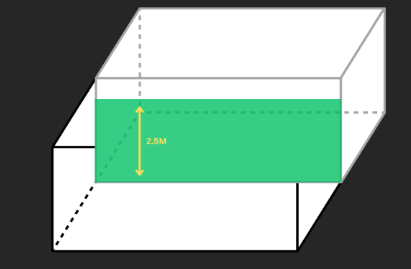
- The rear of the partitioning walls must be dressed above 2.4m in a plain, neutral colour to a maximum height of your stand.
- Branding and logos are not permitted on the rear of dividing walls where these overlook neighbouring Exhibitors.
- Exhibitors may not use the back of the other stand walls without the consent of the exhibitor concerned.
- Exhibitors adjoining a shell scheme stand may not use the reverse of the neighbouring shell as their dividing wall.
Walling on open sides
- Solid runs of construction or walling along gangway edges are forbidden.
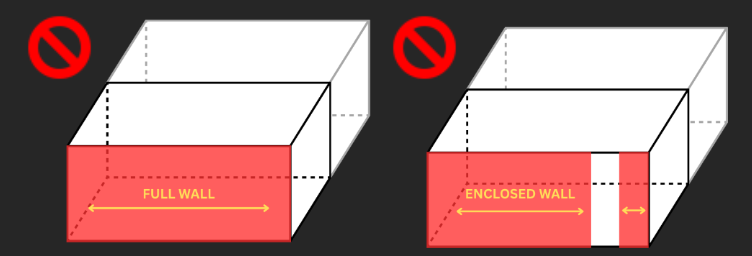
- All stands, irrespective of height, must have at least 50% of each frontage either open or fitted with (approved) transparent material with no more than a 4m continuous run of solid walling.
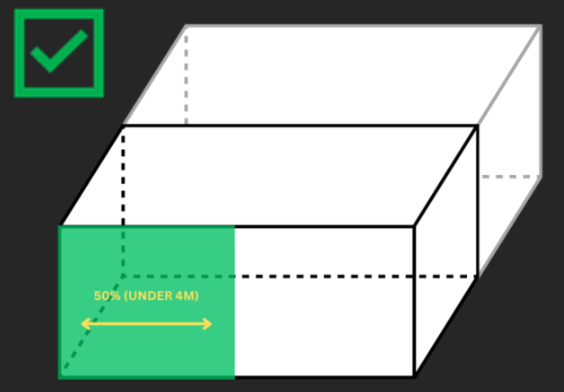
- If using glass for transparency, it cannot take up over 40% of the open side and it must be 100% transparent
- Where runs of walling are to exceed 4m a minimum of 1m visual break must be incorporated.
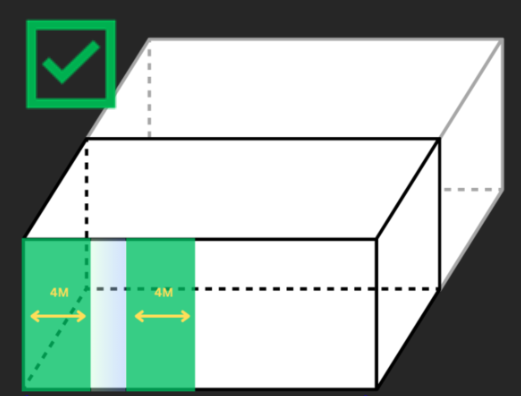
The break must span 0.5m to 2m in height measured from the building floor. This ensures a break for both wheelchair users and standing people. Furthermore, a visual break must be 100% transparent. Frosted windows will not be permitted as this contravenes a visual break.
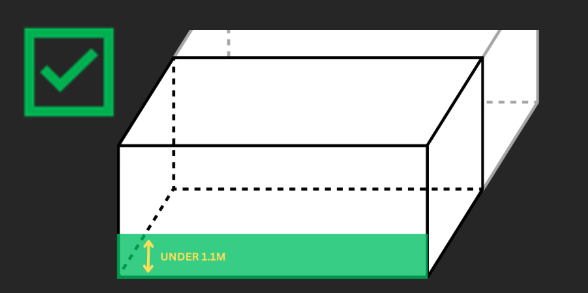
- Walls under 1.1m are permitted and aren’t included in the 50% or 4m rule
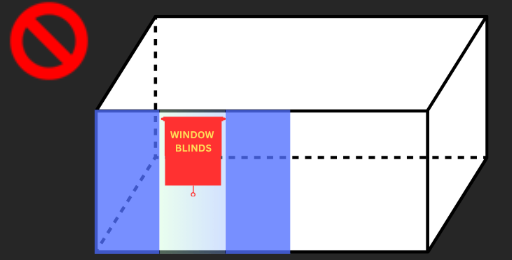
- No blinds, curtains or window dressings are permitted on windows – they must always be transparent throughout.
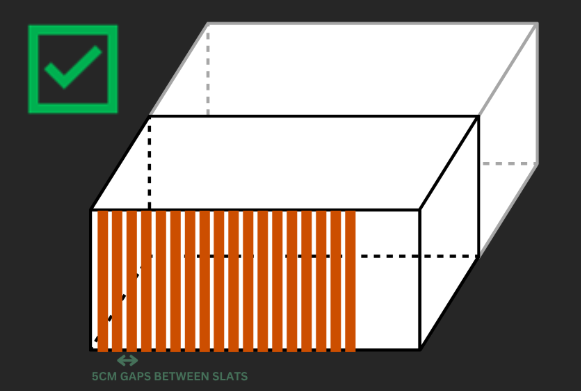
- Slats are permitted with a minimum of 5cm gaps between each slat
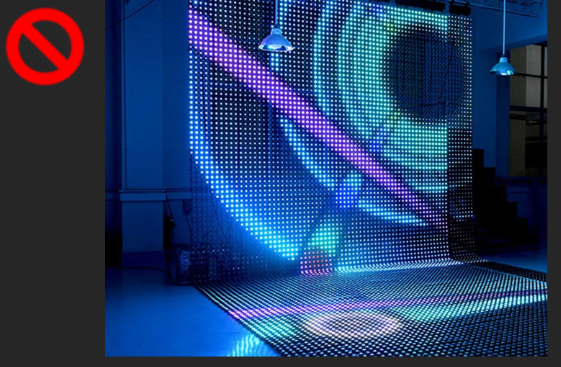
- LED Mesh does not count as a transparent material, as once the visuals are displayed, it is no longer transparent.
Waste
Unmanaged waste poses safety risks, including injury, increased threat of fire, blocks fire exits and hinders access for medical teams in emergencies. Our health and safety policy prohibits the accumulation of waste on stands, in storage areas, in gangways and in communal areas. Waste generated from the construction and dismantling of stands must be removed at the end of each day.
Each exhibitor or their appointed stand contractor will be required to contract a minimum m3 standard waste management via ServiFira. The requirement is determined by stand size. Each exhibitor/contractor will need to show proof that they have ordered the corresponding m3 waste management through ServiFira before they can obtain the Drawing Inspection Notice. See the below requirement:
|
Stand Size |
M3 Build Up |
M3 Breakdown |
240l Build Up |
240l Breakdown |
Total |
|---|---|---|---|---|---|
|
<25m2 |
0 |
0 |
1 |
1 |
2 |
|
25m2 - 50m2 |
1 |
1 |
0 |
0 |
2 |
|
50m2 - 150m2 |
1 |
2 |
0 |
0 |
3 |
|
150m2 - 300m2 |
2 |
3 |
0 |
0 |
5 |
|
300m2 - 600m2 |
3 |
20 |
0 |
0 |
23 |
|
600m2 - 1200m2 |
20 |
40 |
0 |
0 |
60 |
|
Over 1200m2 |
Consult the Organisers. |
||||
Order your waste removal services via the ServiFira webshop by Friday 29th November 2024 to guarantee the best rate. Failure to order the required waste removal services ahead of arriving onsite for build-up and breakdown will result in you not being permitted to commence the construction of your stand.
If a large amount of waste needs to be removed, a container must be ordered through ServiFira at an additional cost. The removal of large quantities of waste is not included in the m3 standard waste management and will be invoiced if not ordered. If waste is not management appropriately or timely, further sanctions may apply.
All space only stand must submit a Waste Management Plan. Your Waste Management Plan must be submitted alongside your stand plan submission.
It is not permitted to use the bathroom sinks for the build-up and breakdown work. The designated industrial sinks must be used for these activities.
Fly tipping, or the dumping of waste illegally instead of using an authorised method, is prohibited. If you are found to have fly tipped your waste within the halls, the lorry ways, or the vicinity of the Venue, fines or sanctions will apply.
At the end of the breakdown period, the contracted surface must be completely clean, which includes removing the adhesive carpet tape and any other material. Any Exhibitors that still have waste will be charged the cost of cleaning and waste removal to restore the conditions of the contracted space.
Order your waste removal services via the Fira Store by the deadline to guarantee the best rate. Failure to order the required waste removal services ahead of arriving onsite for build-up and breakdown will result in you not being permitted to commence the construction of your stand. You will not receive a Drawing Inspection Notice until waste removal services have been booked.
If a large amount of waste needs to be removed, a container must be ordered through Fira Store at an additional cost. The removal of large quantities of waste is not included in the m3 standard waste management and will be invoiced if not ordered. If waste is not managed appropriately or timely, further sanctions may apply.
All space only Exhibitors must submit a Waste Management Plan. Your Waste Management Plan must be submitted alongside your stand plan submission.
It is not permitted to use the bathroom sinks for the build-up and breakdown work. The designated industrial sinks must be used for these activities.
Fly tipping, or the dumping of waste illegally instead of using an authorised method, is prohibited. If you are found to have fly tipped your waste within the halls, the lorry ways, or the vicinity of the Venue, fines or sanctions will apply.
At the end of the breakdown period, the contracted surface must be completely clean, which includes removing the adhesive carpet tape and any other material. Any Exhibitors that still have waste will be charged the cost of cleaning and waste removal to restore the conditions of the contracted space.
Please note waste orders onsite will receive a 20% surcharge.
Water & Drainage
Water connections may be available for your stand depending on where it is located.
If you are planning to exhibit with water features, you must notify the Organisers for approval via the ICE 2027 - Special Activities Form You must ensure no water leaks are in place and that all water is treated and that this is fully described on your Risk Assessment. The Organisers reserve the right to stop any water feature on exhibition stands if these safety measures are not in place.
All exhibitors wishing to use water on their stands must note the following:
- Water and drainage outlets can be found within the halls, but if any additional outlets need to be installed, these will be charged to the exhibitor who has requested them. Contact Fira Store for more information.
- Pressure piping with double-sided threads must be used. Water pressure in the Fira piping system is 4 bars and at night, can reach up to 5 bars. For arrangements that require constant water pressure, it is recommended that regulators are used and, if necessary, devices installed to maintain or increase the pressure.
- The Organisers takes no responsibility for interruptions or irregularities in the water supply. Without exception, the basic regulations governing internal installations to supply water must be complied with.
- The installation of toilets is not allowed.
Welding Equipment & Hot Works
For safety reasons, cutting and welding work cannot be carried out without the prior approval from the Organisers.
Guidance on Construction and Dismantling of Structures
Method statements, risk assessments and construction and dismantling phase plans must be submitted alongside your stand plans to Event Support Solutions.
All persons involved in the work must be competent to undertake the work and have read and understand the method statement, risk assessments and erection and dismantling sequence(s).
- Competent supervision is required, and supervisors must be trained and understand the work they are to supervise. They must be able to read and understand the drawings and method statements and ensure that they are appropriate for the structure and its location.
- A thorough inspection of orientation, columns, obstacles, and service chests must be made.
- Weights of components should be clearly marked and where necessary, lifting points indicated.
- There are hazards when working on a construction site. You should always attempt to design out risks at source by using a safer substitute and therefore prevent an accident. A risk assessment must be submitted alongside your stand plan submission.
- Components should be stacked and delivered so that they can be removed in the desired order, and a plan should be considered for re-loading for removal from site after the event.
- Hard hats and steel toe-capped boots are necessary Personal Protective Equipment for working with steel structures. It may be necessary to cordon off the areas when overhead working is taking place.
- As much of the construction and dismantling as possible should be completed at floor level. This should include decking and the erection of handrails to ensure a safe place of work on the upper level. Where live edge working is necessary, additional safety measures such as temporary edge protection and fall restraint or arrest systems are required.
- Welding and cutting (fabricating) is not allowed within the venue without the prior written consent of the venue.
- Plant and equipment must only be operated by a competent person and copies of their licenses or certificates must be available for inspection at any time.
- Exhibitors are responsible for ensuring their stand contractor employs safe working practices and are aware of their responsibilities under local legislation.
- The structure must be completely self-supporting and stable. No stand should be supported by direct suspension from the roof of the exhibition halls, nor may any fixing be made to the structure of the building. Nothing may be drilled, attached or bolted to the hall floor.
- It is prohibited to apply cement to the floor.
- The Venue has escalators, travellators, and public elevators. This equipment cannot be used to transport, lift, or move elements for constructing or decorating stands. During the periods of build-up and breakdown, this equipment shall be temporarily kept out of use.